Interactive photo booth rentals combine photography, guest interaction, and digital or printed keepsakes in a staffed or self-service event experience. They can make a wedding, conference, or party more participatory through options such as themed backdrops, GIFs, and branded sharing. Their value is practical as well as entertaining: the U.S. Bureau of Labor Statistics reported that Americans spent an average of 2.6 hours per day on socializing and communication in 2023, while event planners increasingly use interactive experiences to encourage guests to connect and create shareable memories. Choosing a booth involves matching its format to the event, checking equipment and accessibility, planning privacy and data handling, and measuring whether the experience met its goals.
Interactive Photo Booth Rentals: Formats, Features, and Event Value
An interactive photo booth rental is a temporary service that supplies a photo-taking setup, capture software, and often an attendant, props, prints, or digital delivery. The term covers a range of formats rather than one fixed device. The Photo Marketing Association International has described photo booths as systems that capture and deliver images for personal or promotional use; in event settings, interaction features extend that basic function through customization, sharing, and participation.
Demand aligns with the scale of the events economy. The Events Industry Council’s 2023 Global Economic Significance of Business Events study estimated that business events generated $1.6 trillion in direct spending worldwide in 2019, the latest pre-pandemic baseline in that report. That figure does not measure photo booth demand specifically, but it illustrates the large market in which event experiences compete for attendee attention.
Enclosed, open-air, and mirror booth formats
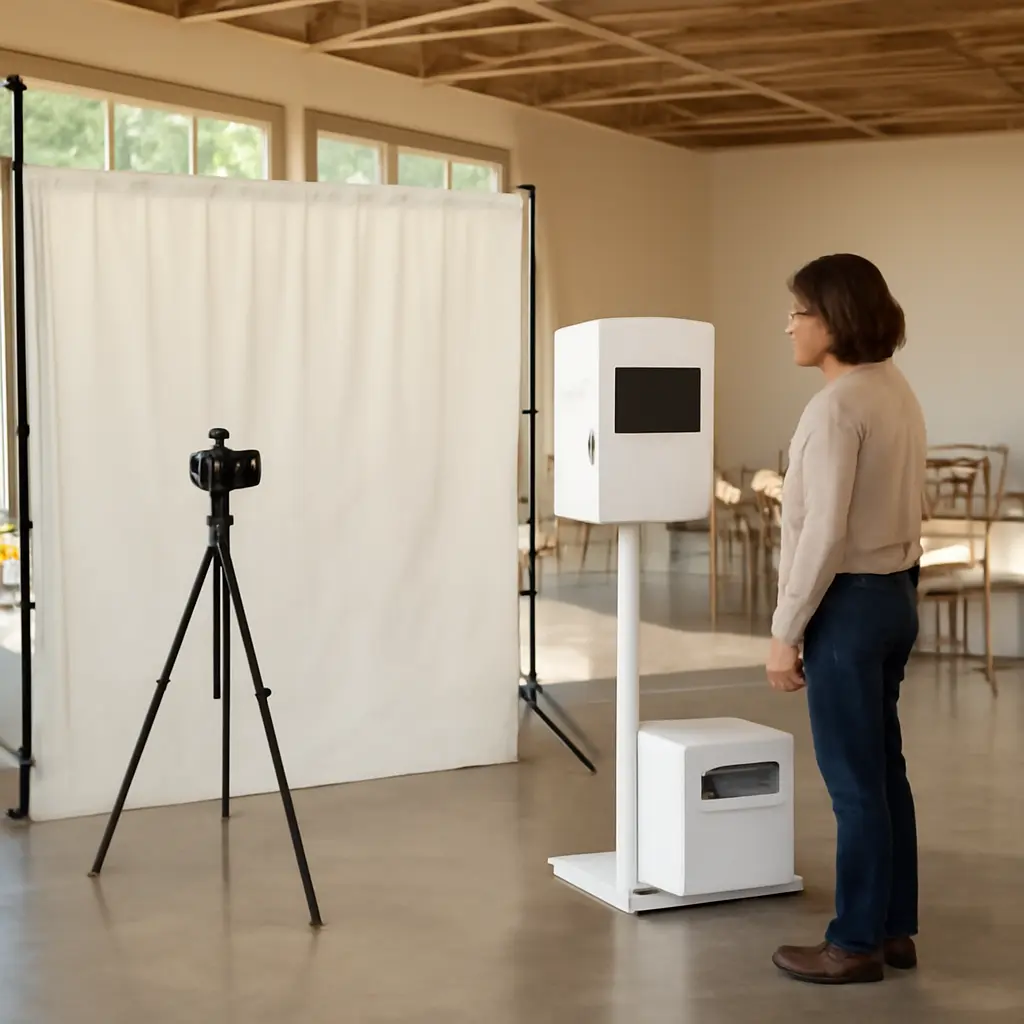
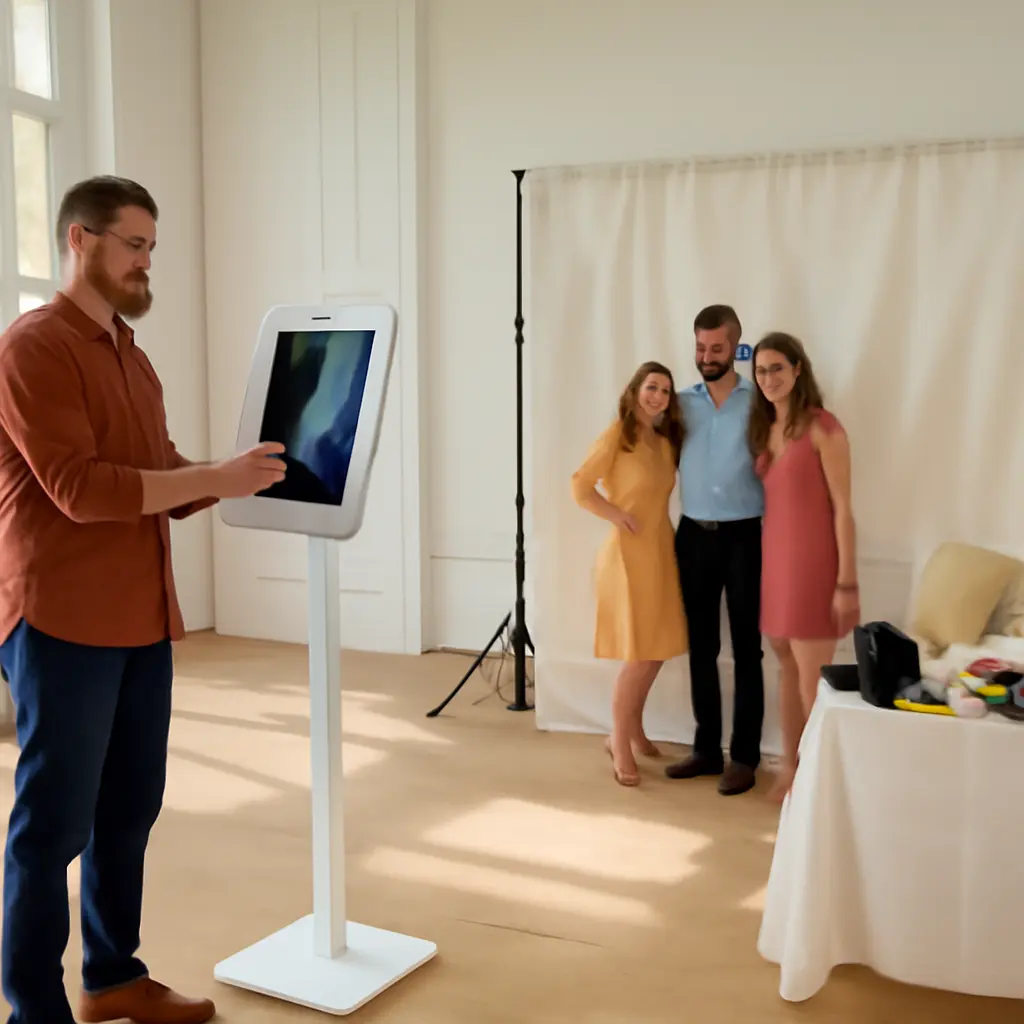
An enclosed booth places guests inside a curtained or walled space, offering privacy and a classic strip-photo experience. An open-air booth uses a camera, lighting, and backdrop in a more visible arrangement, making it easier to accommodate groups and fit varied venue layouts. A mirror booth integrates a camera and touch interface into a full-length reflective screen; animations and prompts guide users through the session. These are hyponyms of the broader rental category, and each suits different constraints: privacy, group size, available floor area, and desired visual style.
360-degree video and roaming capture
A 360-degree booth records a person or group as a camera rotates around a platform, usually producing a short slow-motion or effects-driven clip. A roaming booth, by contrast, uses a photographer or mobile capture device to take pictures across the venue rather than at a fixed station. Both increase movement and visibility, but need different operational planning: a 360 platform requires a clear safety perimeter, while roaming capture depends on crowd flow, lighting, and guests’ comfort with being photographed.
Once the format is selected, the next decision is what interaction the booth should offer. The strongest setups connect their features to the event’s purpose instead of adding technology for its own sake.
Interactive Photo Booth Rentals: Features and Guest Experience
Interactive features are the controls and creative options that let guests shape, receive, or share their images. They may include touchscreens, digital props, branded overlays, animated GIFs, text or email delivery, and social sharing. Their effectiveness depends on straightforward instructions, quick operation, and a clear choice about whether a guest wants to participate.
Customization, props, and event branding
Customization adapts the booth’s appearance and outputs to the event, for example through a coordinated backdrop, a print layout, or a digital frame containing a company logo and event date. Props can reduce hesitation and encourage group participation, while a themed backdrop can make the resulting images recognizable as part of the occasion. For corporate events, branding should remain legible without overwhelming the photograph; for private celebrations, personalization may focus on names, colors, and shared references.
Digital sharing, GIFs, and prints
Digital delivery gives guests a copy by text, email, QR code, or a private online gallery; GIF and short-video modes add motion. Instant prints offer a physical keepsake and can be useful where guests prefer not to use a phone. The choice has practical consequences: digital sharing needs reliable connectivity and a plan for handling contact information, while printing requires paper, ink, and enough time for queues. The Pew Research Center reported that 91% of U.S. adults owned a smartphone in 2023, making phone-based delivery familiar for many guests, though it should not be the only option available.
Accessibility and inclusive participation
An inclusive booth is designed so guests with different mobility, sensory, and communication needs can participate. Consider step-free access, enough turning space, controls within reach, readable on-screen prompts, and an alternative to flashing effects or loud cues. The U.S. Centers for Disease Control and Prevention estimates that 1 in 4 U.S. adults has a disability, making accessibility a meaningful part of event planning rather than an edge case. Ask the venue and rental provider about setup dimensions and available accommodations before booking.
These guest-facing features create the visible experience, but reliable results depend on production decisions behind the booth. Space, staffing, connectivity, and privacy need to be settled before the event begins.
Interactive Photo Booth Rentals: Planning, Safety, and Privacy
Planning a booth rental means coordinating the service with the venue, schedule, audience, and event objectives. A useful brief identifies expected attendance, booth hours, output type, branding requirements, and who will manage questions or technical issues. These details help providers recommend an appropriate setup and clarify what the quoted price includes.
Space, power, and queue management
A booth requires more than the footprint of its camera or kiosk. Allow space for the backdrop, lighting, guest groups, an attendant, and a queue that does not block exits or event traffic. Confirm power access, cable routing, ceiling height, load-in timing, and whether venue rules restrict adhesives or freestanding structures. For 360-degree setups, establish a stable platform and a marked perimeter so nearby guests do not enter the camera’s path.
Staffing, reliability, and contingency plans
A staffed rental can help guests use the equipment, manage queues, replace consumables, and respond to technical problems. Before booking, ask whether setup and teardown are included, what happens if equipment fails, and whether the provider has backup cameras, printers, or connectivity options. For digital delivery, test the venue’s signal or arrange an offline capture process with later delivery. A short technical check before doors open can catch framing, lighting, and printer issues while there is still time to fix them.
Consent, data retention, and image use
Photo privacy planning explains what is captured, how guests receive images, who can access files, and how long data is retained. Place a clear notice near the booth, avoid requiring unnecessary personal details, and ask the rental company whether images are stored on a device, in a gallery, or with a third-party platform. For corporate activations, distinguish guest access to their own photos from permission to reuse images in marketing. The Federal Trade Commission advises businesses to collect only personal information they need and protect it appropriately; event organizers should apply the same data-minimization principle when requesting email addresses or phone numbers.
With logistics and safeguards established, organizers can assess whether the rental delivered value. Measurement should reflect the reason the booth was booked, not simply the number of photographs taken.
Interactive Photo Booth Rentals: Budget, Outcomes, and Evaluation
Photo booth rental costs vary with location, service duration, equipment, staffing, print volume, customization, and delivery features. Compare written quotes on an equivalent basis: hours of operation, setup time, attendant coverage, travel fees, taxes, print limits, gallery access, and cancellation terms. A lower headline price may exclude the features that matter most to the event.
Choosing a package by event objective
For a wedding or private party, the priority may be an easy-to-use booth, prints, and a keepsake gallery. A conference may favor fast group capture, accessible placement, and branded digital delivery. A product launch may use a custom backdrop and social-ready images to support campaign reach. Match the format to the objective, then ask the provider for a sample output and a clear list of inclusions rather than relying on package names alone.
Measuring participation and impact
Useful measures include sessions completed, estimated participation relative to attendance, print or digital delivery counts, peak queue time, and guest feedback. For promotional events, track voluntary sharing or branded engagement only with appropriate notice and consent. These metrics describe activity, not necessarily satisfaction or business impact; a short post-event survey can add context about whether the booth helped guests connect, remember the event, or understand a campaign.
A practical example is a conference organizer choosing an open-air booth with a branded digital frame rather than a small enclosed unit. The open setup can accommodate colleagues in one image, while a staffed station helps maintain flow. If the organizer also offers an unbranded print option and explains digital data use, the experience can balance sponsor visibility with guest choice. This illustrates why format, interaction, operations, and privacy should be planned as one service.
Conclusion: Interactive Photo Booth Rentals as Event Experiences
Interactive photo booth rentals range from enclosed and open-air photography to mirror, 360-degree, and roaming experiences. Their features—customization, digital sharing, prints, and inclusive design—work best when selected for the event’s audience and purpose. Careful attention to space, staffing, safety, consent, and data retention makes the experience more reliable, while participation and feedback measures help organizers judge its value. Before booking, compare itemized quotes, confirm venue requirements, review privacy practices, and request a demonstration of the guest journey.
Sources: U.S. Bureau of Labor Statistics, American Time Use Survey, 2023 Results, https://www.bls.gov/news.release/atus.nr0.htm; Events Industry Council, Global Economic Significance of Business Events, 2023, https://insights.eventscouncil.org/Full-Article/global-economic-significance-of-business-events; Pew Research Center, Mobile Fact Sheet, https://www.pewresearch.org/internet/fact-sheet/mobile/; U.S. Centers for Disease Control and Prevention, Disability Impacts All of Us, https://www.cdc.gov/disability-and-health/articles-documents/disability-impacts-all-of-us.html; Federal Trade Commission, Protecting Personal Information: A Guide for Business, https://www.ftc.gov/business-guidance/resources/protecting-personal-information-guide-business; Photo Marketing Association International, Photo Imaging Industry resources, https://www.pmai.org/