A photo booth rental is a temporary event service that provides guests with a camera, a way to pose, and usually digital or printed keepsakes. The right choice depends on your event’s audience, space, budget, and goals—not simply on which booth has the most features. Compare booth formats, guest capacity, accessibility, print and sharing options, attendant support, and the full contract price. Those checks matter because event experiences are a significant part of how people engage with gatherings: Eventbrite’s 2024 Social Study found that 73% of surveyed consumers said they were more likely to attend an event if it offered a unique experience. A well-matched booth can turn that interest into participation, while a poor fit can create queues, surprise costs, or disappointing photos.
Choosing a Photo Booth Rental: Event Fit and Guest Experience
There is no universally best photo booth. The best rental is the one that suits the event’s purpose and audience, works within the venue, and provides dependable service at a clearly stated total price. Start by deciding what you want guests to do: take a quick portrait, make a group keepsake, record a video message, or share branded content.
Match the booth to the event format
A booth is an interactive event feature: guests take photos or video using a camera setup, often with a backdrop, lighting, props, and a delivery option. Weddings and family celebrations may benefit from prints and a guestbook; conferences may prioritize a branded digital gallery; school events may need simple controls and sturdy equipment. Ask vendors for examples from events similar in size and style to yours rather than relying only on polished promotional images.
Plan for participation and flow
A booth’s practical capacity depends on more than its advertised guest count. The number of people who can fit in a frame, how quickly each session runs, whether guests need help, and how the booth is positioned all affect throughput. Eventbrite’s 2024 Social Study reported that 79% of surveyed consumers believed live events were the best way to experience something new. That finding supports treating the booth as part of the guest experience: place it where people can find it, but not where its line blocks food service, entrances, or the dance floor.
Comparing Photo Booth Rental Types and Features
Photo booth rental describes a family of services, not a single machine. The formats below differ in footprint, interaction style, and the type of keepsake they produce. Confirm the exact equipment and outputs in writing, since vendors may use similar labels for different setups.
Enclosed and open-air booths
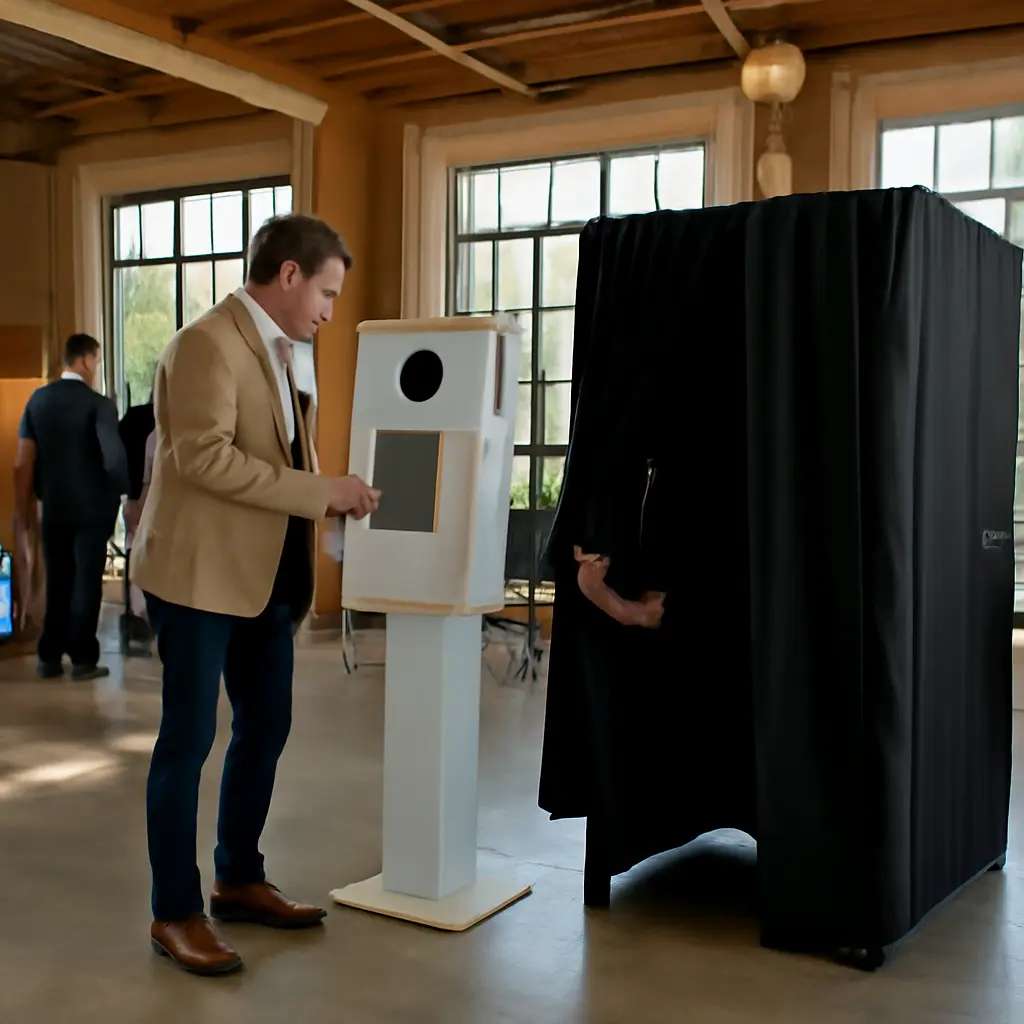
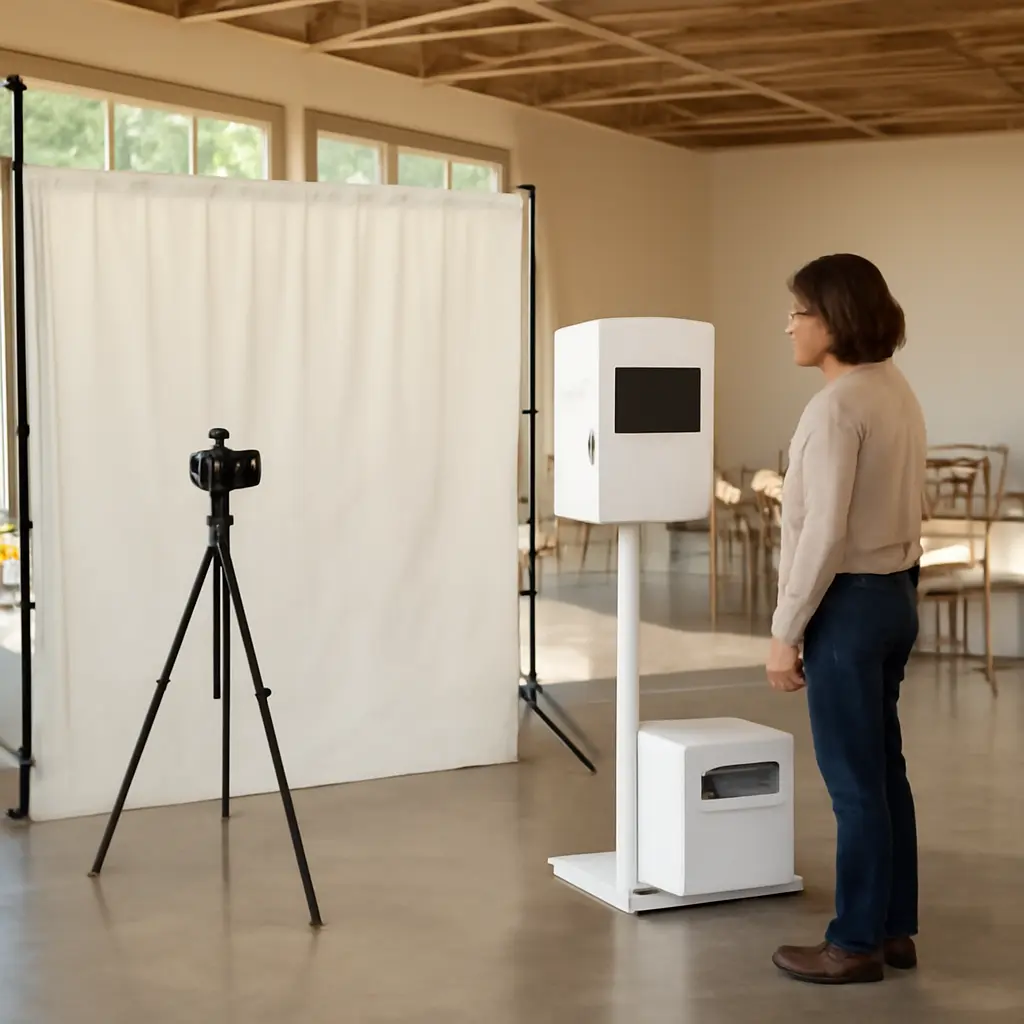
An enclosed booth places guests inside a curtained or walled space for a more private, classic experience. It can work well for smaller groups and traditional strip prints, but its footprint and limited group capacity may not suit every venue. An open-air booth uses a camera and backdrop in an accessible area, making it easier to photograph larger groups and customize the background. Check the venue’s floor plan, ceiling height, power access, and any restrictions on fixtures or backdrops before choosing either format.
Mirror, 360-degree, and roaming booths
A mirror booth uses a touch-enabled reflective screen to guide guests through poses and prompts. A 360-degree booth records short videos as a camera moves around guests on a platform; it can be visually striking but needs a clear, controlled area and close supervision. A roaming booth is operated by a photographer or attendant who takes photos among guests rather than at a fixed station. These formats are best selected for their fit with the event: consider accessibility, safety, noise, queueing, and whether guests will actually want to use the experience.
Prints, digital delivery, and branded design
Prints provide an immediate physical keepsake, while digital delivery makes it easy for guests to save or share images. Some rentals include both; others charge extra for prints, a custom template, a password-protected gallery, or post-event downloads. Ask what file formats guests receive, how long the gallery remains available, and whether the design proof is approved before the event. For corporate events, confirm that logos and brand colors will remain legible on the selected print size and screen layout.
Evaluating Photo Booth Rental Cost, Contract, and Vendor Reliability
A low advertised rate is not necessarily the lowest final price. Photo booth packages can differ in rental duration, setup and travel charges, staffing, prints, props, customization, taxes, and overtime. Compare written quotes against the same checklist so that you are evaluating equivalent services.
Calculate the full rental cost
Request an itemized quote that identifies the hours of operation, setup and breakdown time, travel fees, print quantities, extra-hour rates, and any venue or power requirements. Ask whether the attendant is included and whether there are limits on reprints or digital downloads. The U.S. Federal Trade Commission advises consumers to understand the full cost and terms of a deal before committing; applying that habit to event rentals helps reveal fees that a headline package price may not show.
Verify vendor experience and backup plans
A reliable vendor should explain who will operate the booth, when setup occurs, how technical problems are handled, and what happens if equipment fails or an attendant cannot attend. Request recent galleries or references, confirm that the company has experience with your venue type, and check that the contract names the service date, hours, deliverables, cancellation terms, and payment schedule. For an outdoor event, ask about weather protection and an indoor backup location; for a venue with strict access rules, confirm delivery and loading arrangements in advance.
Review image privacy and accessibility
Photo galleries may contain identifiable images, so ask who can access them, whether guests must opt in to sharing, how long files are retained, and how deletion requests are handled. The U.S. Federal Trade Commission’s guidance on protecting personal information emphasizes collecting and retaining only what is needed and safeguarding data. Also consider physical access: check whether the booth can accommodate mobility devices, whether instructions are readable, and whether guests can participate without using a touchscreen or standing for an extended period.
Planning Photo Booth Rental Logistics for Your Venue
Even a suitable booth can underperform if the site plan is overlooked. Before booking, share the venue layout and schedule with the vendor and have them confirm space, power, access, and operating conditions.
Check footprint, power, and placement
Ask for the booth’s dimensions, including the space needed for a backdrop, lighting, props, queue, and accessible approach. Confirm outlet location and whether the vendor requires a dedicated circuit or a stable internet connection. Place the booth where guests can see it without obstructing exits, accessible routes, catering stations, or the event’s main program. For outdoor use, confirm shade, wind protection, weather limits, and the vendor’s plan if conditions change.
Set the operating hours and staffing expectations
Schedule the booth around guest arrival and the event’s busiest moments, rather than assuming it should run continuously. Clarify whether setup and teardown count toward paid hours, when the attendant arrives, and whether breaks or meal service affect operation. If the booth is a central attraction, ask how the attendant will manage lines and keep the experience moving without rushing guests.
Conclusion: Choose a Photo Booth Rental That Serves the Event
Choosing the right photo booth rental means matching its format and features to the event, then checking total cost, vendor reliability, privacy, accessibility, and venue logistics. Enclosed, open-air, mirror, 360-degree, and roaming options each create a different experience; prints and digital delivery also serve different guest needs. Compare itemized quotes, read the contract, and confirm the floor plan and backup arrangements before paying a deposit. Start by writing down your event goals and venue constraints, then ask at least two vendors to recommend a package against the same requirements.
Sources: Eventbrite, 2024 Social Study, https://www.eventbrite.com/blog/eventbrite-social-study-2024/; U.S. Federal Trade Commission, Shopping and Donating: Get the Most for Your Money, https://consumer.ftc.gov/shopping-and-donating; U.S. Federal Trade Commission, Protecting Personal Information: A Guide for Business, https://www.ftc.gov/business-guidance/resources/protecting-personal-information-guide-business